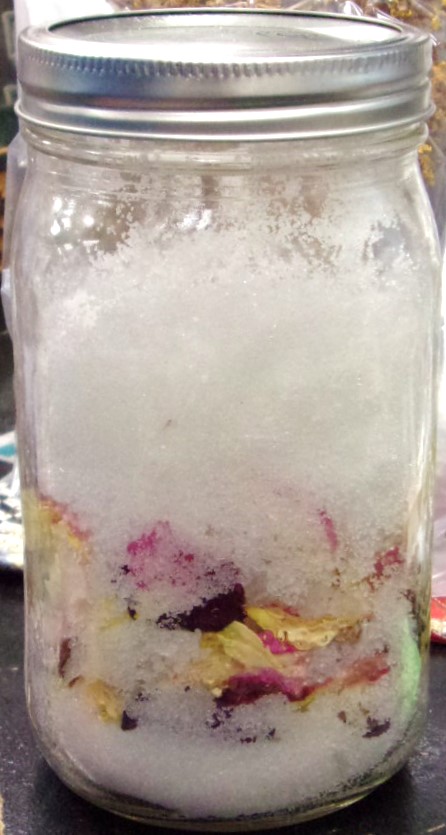
Over the years as I’ve been able to find red rose petals I’ve done many batches of rose sugar. It’s a way of preserving rose petals for their scent/flavor into the winter. I usually use it in tea, but I’ve put it on ice cream and waffles and used it as a flavorant in cookies and cakes. This is a period way of preserving things of this sort, from herbs to berries, some documention for which is listed near the end of the page. I want to show the method, mostly.


6/13/22 – Red rosebush fully in bloom, so rose sugar…
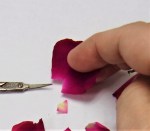
This is the step where you snip the white bases out of the petals. The white part can be bitter!
*
*
6/5/22 – Saturday was Rose Sugar, since the rose is starting to bloom.

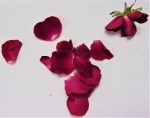


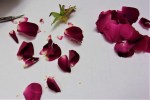


6/13/21 – Cookery – Made Rose Sugar on 6/10 (Thursday).



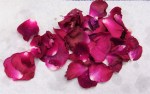
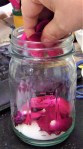

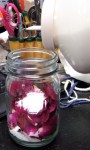
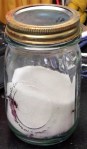
From 6/25/14
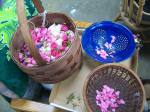


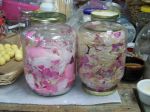


From 11/13/19 – Sugar-Preserved Strawberries (or roses!)
Quoting from https://housecapuchin3.wordpress.com/portfolio/activities-through-7-1-18/ [This link has process pictures as well as this recipe/method]
Strawberries – On Saturday, as part of herbs, we prepped most of a 2 pound box of strawberries. The best got eaten. The least ripe went into a strawberry pickle and the most ripe and bits went into a sugar preserve and the 5 left over got frozen for breakfast. Now, we don’t have a clue how period these methods are… at least for strawberries. All the strawberries were cleaned, sliced and packed at the same time, then the pickling brine got done and added.
So, first the sugar preserve… the method is from Townsends. – https://www.youtube.com/watch?v=UNTpZkiiqUs
- Take your container (1 pt canning jar) and put a layer of sugar on the bottom.
- Make a layer of strawberry slices and pieces.
- Cover with sugar.
- Tap down by tapping the jar on the table and add more only if necessary.
- Alternate until the jar is full, ending with a layer of sugar.
- Keep in the fridge until the sugar has turned into syrup and the strawberries are partially dehydrated, then eat. About a month for them to “finish”.
Steven Angelo – Interestingly, your post mentioning rose sugar made me research it to see if it was exactly what it seemed to be (it is); and in doing so, I came across this article that cites a 1594 recipe for such.
So at least 16th century if not quite “period”.
“ The following is a recipe from Delights for Ladies by Sir Hugh Platt, published in 1594:
Dip a rose that is neither in the bud, nor over-blowne, in a sirup, consisting of sugar, double refined, and Rose-water boiled to his full height, then open the leaves one by one with a fine smooth bodkin either of bone or wood; and presently if it be a hot sunny day, and whilest the sunne is in some good height, lay them on papers in the sunne, or else dry them with some gentle heat in a close roome, heating the room before you set them in, or in an oven upon papers, in pewter dishes, and then put them up in glasses; and keepe them in dry cupboards neere the fire. You may prove this preserving with sugar-candy instead of sugar if you please.”
See the full post: https://toriavey.com/…/the-old-fashioned-way-sugared…/
Daniel Myers – To preserve all kind of fruits that they shall not break in the preserving. Take a Platter that is plaine in the bottom and lay Sugar in the bottom, then Cheries or any other fruit, and so between every row you lay, throw sugar and set it upon a pots head, and cover it with a dish, and so let it boyle. [A Book of Cookrye (England, 1591)]
MaryAnne Anja Bues Bartlett These don’t need to be boiled… is it possible that the “boyle” above means to ferment?
Daniel Myers I don’t think so. The language around recipes was pretty stable by then.
Ea Fleming Petits Propos Culinaires (PPC) #20, “Rose Sugar and Other Medieval Sweets” by Joop Witteveen, has two definitely period methods of making rose sugar (“suker rosaet). Layers are not specified, but, looking at Steven Angelo link, those roses don’t appear to be layered either. The “Naturen Bloeme” recipe, between 1265 and 1270, says: “Rose sugar (suker rosaet) is made in the following way: rose petals that have been rubbed fine with sugar are put in a glass jar and left in the sun for 30 days; the contents must be stirred daily; the jar must be well sealed and it will remain good for three years.” (Eelco Verwijs, Jacob van Maerlant’s Naturen Bloeme.”
Witteveen also cites a 1600 Dutch recipe: “Take as many red roses as you wish and rub them very fine, adding three times as much sugar. Mix this well and set it well sealed in the sun. Mix it now and then with a spatula.” (Carolus Battus, Secreet-Boeck van veele diversche en heerlicke Consten in veelderleye Materiën.”
Those two seem to say the same thing so that looks like at least 400 years in The Netherlands of making rose sugar.
Page created and published 8/25/24 (C)M. Bartlett
Last updated 8/25/24
 House Capuchin 3